Spanish 21 is one of the few blackjack variants where the casino openly hands you a worse deck and then hands back more than it took. The deck is weaker. The rules are far better. When you play it correctly, a good Spanish 21 table can beat a typical six-deck shoe game. When you play it with standard blackjack strategy, you give away most of that advantage.
This guide breaks Spanish 21 down piece by piece. You will learn what the 48-card deck costs you, which bonus rules pay that cost back, where your strategy has to change, and how to use the Double Down Rescue rule like a professional. My job is to get you to the table ready to play. For the full equations, I will point you to the people who derive them.
The Anatomy of the Spanish Deck
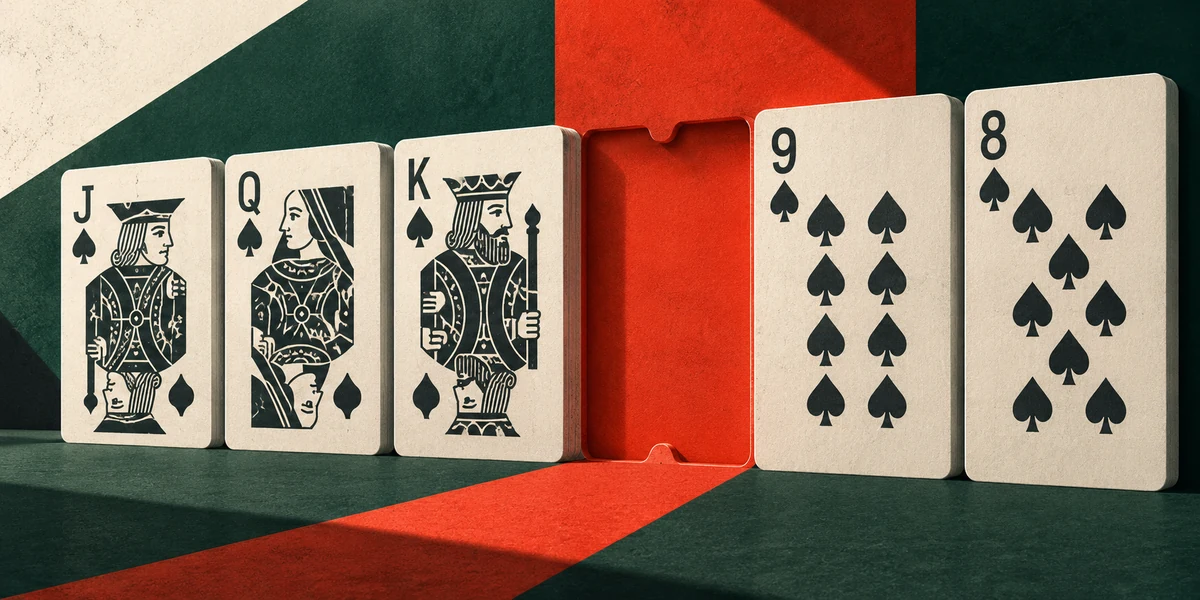
A Spanish deck is a standard 52-card deck with the four pip 10s removed: the ten of spades, hearts, diamonds, and clubs. Jacks, Queens, and Kings all stay in. Each deck therefore has 48 cards, and most Spanish 21 games deal from a six-deck or eight-deck shoe built from these decks.
The change looks small. It is not. In a standard deck, 16 of the 52 cards are worth ten (four 10s plus twelve face cards), so ten-value cards make up 30.77% of the deck. In a Spanish deck, only the twelve face cards remain out of 48, which drops ten-value density to 25.00%. You lose almost one ten-value card in every five.
Nearly every strategic difference in Spanish 21 traces back to that 5.77-point drop. Ten-value cards are the player's best cards in blackjack. They make naturals, they turn doubled 10s and 11s into 20s and 21s, and they bust dealers who are forced to hit stiff hands. Remove a quarter of them and the whole game shifts toward the house, unless the rules push it back.
Key Concept
Ten-value density falls from 30.77% to 25.00% in a Spanish deck. Every rule and strategy change in Spanish 21 is a reaction to that one fact. When you are unsure about a play, ask yourself: "How does having fewer tens change the risk here?" The answer usually points you to the right decision.
Why Removing Tens Costs You Roughly 2%
Take an ordinary blackjack game and swap in Spanish decks while keeping every other rule the same. The house edge rises by roughly 2.0 percentage points. A break-even game becomes one where you lose about two units for every hundred you bet. Three forces drive that penalty.
1. Fewer Natural Blackjacks
A natural needs an Ace plus a ten-value card. With fewer tens in the shoe, you get fewer naturals, and naturals are the 3:2 payout that carries a large share of the player's expected value in standard blackjack. Losing a meaningful percentage of your blackjacks is a direct cut to your income.
2. Weaker Double Downs
When you double a hard 10 or 11 in a standard game, you are counting on a ten-value card about 31% of the time. In a Spanish shoe that chance falls to 25%. Your doubled hands finish on 20 or 21 less often, so the extra money you put out earns less. Several doubles that are automatic in standard blackjack become marginal or wrong in Spanish 21.
3. Fewer Dealer Busts
The dealer must hit stiff hands. Fewer tens in the shoe means the dealer's 12 through 16 bust less often. Your stand-on-stiffs strategy against small upcards in standard blackjack relies on dealer busts. Here, that strategy is weaker.
If you want the exact effect of removing specific ranks, you can study the card removal impact formulas on BlackjackMath.org. You do not need to memorize them. You need to accept the practical result: the deck works against you by about 2%, and the rules have to win that back.
The Compensating Rules: Where You Win It Back
Spanish 21 makes up for the missing tens with a set of rules that standard blackjack players rarely see together. Together they move the game back toward even.
Player 21 Always Wins
In standard blackjack, your 21 pushes against a dealer 21. In Spanish 21, your 21 wins. If you build a five-card 21 and the dealer turns over a three-card 21, you get paid. The one exception is a dealer natural. The dealer checks for blackjack first, and a dealer blackjack still beats a player's non-blackjack 21.
Player Blackjack Always Wins
Your natural beats everything, including a dealer natural. It is paid at 3:2 right away. A blackjack-versus-blackjack hand is a push in standard play. Here it is a full win.
Late Surrender
Spanish 21 allows late surrender. After the dealer confirms there is no blackjack, you can give up half your bet and leave a bad hand. Some rule cards limit surrender to your first two cards. Others are more generous. Read the felt and the placard before you sit down, because the difference affects your strategy. If surrender is new to you, start with our late surrender guide.
Double Down Rescue
This is the rule that really sets Spanish 21 apart. After you double and see your card, you may forfeit an amount equal to your original wager and take back the rest. If you put out $25 and doubled to $50, then caught a 4 on your 11 against a dealer Ace, you can give up $25 and take $25 back. In effect, it is a surrender option after doubling. It lowers the cost of aggressive doubles, which matters a great deal in a deck that has fewer tens.
Liberal Doubling and Splitting
Most Spanish 21 tables also offer:
- Doubling on any number of cards.
- Doubling after splitting.
- Re-splitting Aces.
- Hitting split Aces.
- Redoubling, often up to three times, at the best tables.
Each of these rules is worth a small amount. Combined, they are significant.
The Bonus Payout Structure
The bonus 21 payouts are the most visible feature of Spanish 21. They are also what make its strategy so different from standard blackjack.
| Bonus Hand | Typical Payout | Strategic Note |
|---|---|---|
| 5-card 21 | 3:2 | Drives extra hitting on 4-card stiffs |
| 6-card 21 | 2:1 | Makes hitting 5-card hands more attractive |
| 7+ card 21 | 3:1 | Rare, but adds value to deep draws |
| 6-7-8 or 7-7-7 (mixed suits) | 3:2 | Affects certain 13 and 14 decisions |
| 6-7-8 or 7-7-7 (same suit) | 2:1 | Same as above, with a higher payout |
| 6-7-8 or 7-7-7 (all spades) | 3:1 | Highest regular three-card bonus |
| Super Bonus: suited 7-7-7 vs. dealer 7 upcard | $1,000–$5,000 + $50 Envy Bonus to table mates | Often requires a minimum bet; never adjust strategy for it |
The Super Bonus usually pays $1,000 on smaller wagers and $5,000 once your bet reaches a stated minimum, commonly $25. Everyone else at the table collects an Envy Bonus. It is exciting and very rare. It should never change a decision.
Warning:
On most rule cards, bonus payouts do not apply to doubled hands, and many venues also exclude split hands. If you double a 4-card 11 and make 21, you usually get even money, not 3:2. Before you double a multi-card hand, check whether you are giving up a bonus by doing it. Players who skip the placard lose money on this rule every session.
House Edge: Where Spanish 21 Ranks
Rules decide everything. With the dealer standing on soft 17 and redoubling allowed, six-deck Spanish 21 has a house edge of about 0.40% with perfect strategy. That beats a typical six-deck standard shoe at about 0.50%. If you switch to dealer hits soft 17 and remove redoubling, the edge rises to the 0.75%–0.80% range. That is a meaningful drop in quality.
| Game / Rule Set | Approx. House Edge | Verdict |
|---|---|---|
| Spanish 21, 6D, S17, redouble allowed | ~0.40% | Excellent. Play it. |
| Standard blackjack, 6D, S17, DAS | ~0.50% | Solid baseline |
| Spanish 21, 6D, H17, redouble allowed | ~0.80% | Playable, not ideal |
| Spanish 21, 8D, H17, no redouble | ~0.85%+ | Look elsewhere |
| Spanish 21 played with standard basic strategy | Well above 1% | The most common way to lose this game |
These are rounded figures meant for choosing a table. For exact values by rule combination, see the Spanish 21 mathematical derivations on BlackjackMath.org. To score the specific table in front of you, enter its rules into our Table Grader tool.
Critical Strategy Divergences
This is where players either collect the 0.40% game or lose far more. Spanish 21 strategy is not standard basic strategy with small changes. It depends on how many cards make up your hand, not only your total.
Stiff Hands: Hitting Is Safer
Fewer tens means hitting a stiff hand is less likely to bust you. A hard 15 in standard blackjack busts on any ten-value card, about 31% of the deck. In a Spanish shoe the same draw busts on about 25%. Meanwhile, the dealer's small upcards bust less often for the same reason. Both changes push you toward hitting. If you need a refresher on the standard logic first, read our stiff hands 12-16 guide, then use the changes below.
Against Dealer 7 Through Ace: No Hesitation
Against a dealer 7, 8, 9, 10, or Ace, you hit hard 14, 15, and 16, or surrender where the rules allow and the chart calls for it. That is already correct in standard blackjack, but in Spanish 21 there is even less reason to hesitate. The dealer is strong, your bust risk is lower, and your 21 beats theirs. Standing on 16 against a 10 because you "feel" a bust coming is a bad play in standard blackjack and a worse one here. Hit, or surrender 16 against a 10 when it is allowed.
Against Dealer 2 Through 6: Count Your Cards
Against weak upcards, the number of cards in your hand decides the play. A two-card 14 against a dealer 4 is a stand. A five-card 14 against the same 4 is often a hit. You have more to gain because a low card can turn the hand into a bonus 21, and the bonus payouts change the expected value of drawing.
Here is how the bonus math works:
- A 4-card 16 that catches a 5 becomes a 5-card 21 paying 3:2.
- A 5-card 15 that catches a 6 becomes a 6-card 21 paying 2:1.
Not every hit reaches 21, and nothing is guaranteed. But the upside of making 21 is larger, and the lower bust risk makes the draw worth taking far more often than standard blackjack suggests.
| Situation | Standard Blackjack | Spanish 21 (Representative) |
|---|---|---|
| Hard 12 vs. 4 | Stand | Hit |
| Hard 13 vs. 2 | Stand | Hit |
| Multi-card 14–16 vs. 2–6 | Always stand | Stand on 2–3 cards; hit more often as card count rises |
| Hard 14–16 vs. 7–A | Hit (surrender some) | Hit or surrender, with even less reason to stand |
| Hard 9 doubles | Double vs. 3–6 | Double far less often, typically vs. 6 only |
| Hard 10 vs. 9 | Double | Often hit, depending on rules |
| Insurance | Never | Never, and it is even worse with fewer tens |
Exact card-count thresholds depend on deck count, the soft 17 rule, redoubling, and whether bonuses pay on doubled hands. Do not guess at them. Build the chart for the table you are playing with the Strategy Chart Builder tool, and practice it until it is automatic.
Sharp Tip (Marcus Vance):
Get into the habit of counting your cards, not just your total. Before every decision on a stiff hand, say to yourself: "fifteen, five cards, dealer five." In my experience, the hand that costs Spanish 21 players the most money is a multi-card stiff against a small upcard, played on autopilot with standard strategy. The chart is not complicated. The habit is what makes the difference.
Doubling Less, Then Rescuing Smartly
Because ten-value cards are scarcer, you will double less often than in standard blackjack. When you do double, Double Down Rescue gives you a way out. The decision rule is simple:
Rescue when the expected loss on your doubled hand is greater than the fixed cost of rescuing.
The rescue costs you exactly one original unit, which is half of your doubled wager. That is the same threshold as standard surrender. If finishing the hand would lose more than 50% of the doubled bet on average, rescue it.
In practice, this usually means rescuing when a doubled hard 10 or 11 lands on a stiff total (12 through 16) against a dealer 10 or Ace. It sometimes applies to higher stiffs against a 9. Against a dealer 2 through 6, keep the double in action. The dealer's bust chance gives you enough equity to play on.
Key Concept
Double Down Rescue caps your worst-case loss on a doubled hand at one unit instead of two. Use it as a variance tool. It limits your risk on doubles that go wrong. It is not a reason to double hands the chart says to hit. It protects correct doubles. It does not turn bad doubles into good ones.
Warning:
Watch out for "Spanish-style" tables that keep the 48-card deck but quietly change the payouts. Examples include lowering the 5-card bonus, removing redoubling, or excluding bonuses after splits. Each change costs a little, and together they can push the game above 1%. If the 10s are gone and the full rule package is not there, walk away.
Table Selection Checklist
Before you buy in, confirm these rules on the placard or the help screen:
- Dealer stands on soft 17. This is the most valuable rule on the list.
- Redoubling allowed. Ideally up to three times.
- Full bonus schedule. 5/6/7-card 21s paying 3:2, 2:1, and 3:1.
- Late surrender and Double Down Rescue both available.
- Re-split and hit split Aces.
- Six decks rather than eight, when you have the choice.
To see how Spanish 21 compares with other alternative games worth your time, read our Blackjack Variants overview.
Sharp Tip (Marcus Vance):
Online, Spanish 21 often deals from a continuously reshuffled shoe, so counting is not an option. Your entire edge comes from rules and strategy accuracy. Keep your chart open on screen. There is no dealer watching and no stigma. Precision is the only thing that matters.
Bottom Line
Removing the four pip 10s from each deck costs you about 2%. Spanish 21's rule package wins that back: 21 always wins, blackjack always wins, late surrender, Double Down Rescue, liberal doubling, and multi-card bonuses. With S17 and redoubling, the house edge is about 0.40%, which beats a standard six-deck shoe. You only get that number with Spanish 21 strategy. Count your cards on stiff hands, hit more aggressively, double less, and rescue doubles that land on stiffs against strong dealer upcards. Grade the table first, build your chart for its exact rules, and leave if the rules have been weakened.