
Late Surrender: The Cheapest Exit in the Casino
Late surrender is the most underused rule at the blackjack table. Many recreational players don't realize it exists, many more know about it and refuse to use it, and a surprising number of competent basic strategy players apply it to the wrong hands. This guide covers the mathematics, the exact hands to surrender under each rule set, how to find tables that offer it, and how to signal it correctly so a dealer or software interface does not turn a cheap exit into an expensive mistake.
Key Takeaway: Late surrender lets you give up half your bet after the dealer checks for blackjack. It is correct whenever playing the hand out is expected to lose more than 50% of your wager. Used on only a handful of hands (mainly hard 16 against 9, 10, or Ace and hard 15 against 10), it cuts the house edge by about 0.08%. That is free money, and refusing it out of pride is a measurable leak.
What Late Surrender Actually Is
Under late surrender (LS), after you receive your first two cards you may forfeit half your wager and end the hand immediately. The word "late" is the whole point. You can only surrender after the dealer has peeked at a ten or Ace upcard and confirmed there is no blackjack. If the dealer has a natural, the hand ends before you get to act, and you lose your full bet as usual.
Three conditions apply almost universally:
- First decision only. Surrender must be your first action on the original two cards. Once you hit, double, or split, the option is gone.
- No surrender after splitting. In nearly all games you cannot surrender a hand created by a split. You may surrender a pair before splitting it, which matters for 8,8.
- Peek games only. True late surrender assumes a hole-card game in which the dealer checks for blackjack. In European no-hole-card (ENHC) games, "surrender" usually means something different and is often worth less. Read the rules carefully.
Before you sit down, scan the felt and placard for the rule. If you are still learning to decode table signage, our guide on how to read a table walks through every common placard abbreviation, including "LS," "Surrender Offered," and "S17/H17."
The Mathematics: Why -0.50 Is the Magic Number
Surrender has a fixed, certain expected value: you lose exactly half your bet. Expressed per unit wagered, EV(surrender) = −0.50. Every other option (hit, stand, double, split) has an uncertain outcome, and its expected value depends on your total, the dealer's upcard, the rules, and the number of decks. The decision rule is simple:
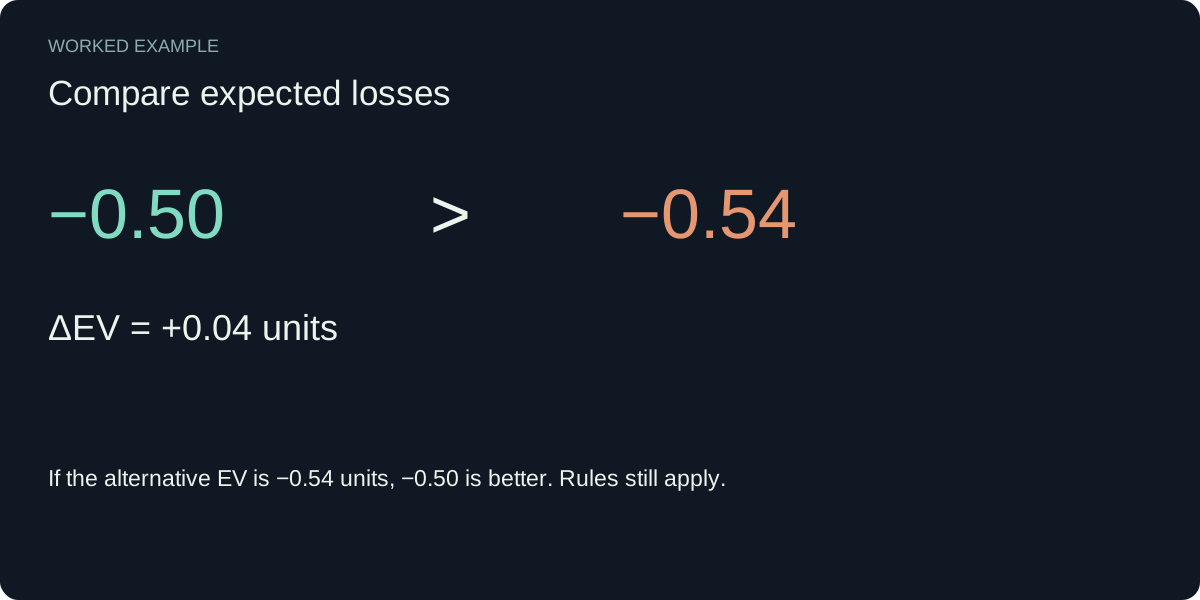
Surrender is correct if and only if the EV of your best alternative play is below −0.50. If hitting 16 against a 10 loses 54 cents per dollar on average, surrendering for a guaranteed 50-cent loss saves 4 cents per dollar every time the hand appears. If the best alternative loses only 48 cents, surrender costs you 2 cents. The threshold is absolute. How "bad" the hand feels does not enter into it.
We can express the threshold in terms of win probability. Ignoring pushes for a moment, a hand that wins with probability p and loses with probability (1 − p) has the following EV:
EV(surrender) = -0.50
Surrender when: 2p - 1 < -0.50
2p < 0.50
p < 0.25
With pushes (W = win prob, L = loss prob, P = push prob):
EV(play) = W - L
Surrender when: L - W > 0.50
Example: Hard 16 vs dealer 10 (multi-deck, dealer has no blackjack)
EV(best play: hit) ≈ -0.54
EV(surrender) = -0.50
Saving per unit ≈ +0.04 (4% of the wager, every occurrence)
On a $100 bet: you save about $4 on average each time you surrender 16 vs 10.
The 25% figure is the intuition to keep. If you will win this hand less than one time in four, and pushes are rare, giving up half is the cheaper outcome. Hard 16 against a 10 wins roughly 23–24% of the time when you hit it out, which puts it just on the wrong side of the line. That is why the saving looks small (about 4%) but is entirely real.
For the full derivations, including how the post-peek conditioning on the dealer's hole card changes the probabilities, see the surrender EV formulas and derivations on BlackjackMath.org. We don't reproduce their complete EV tables here. Use their reference for exact per-hand values by deck count and rule set.
Where the 0.08% Comes From
The roughly 0.08% house-edge reduction is a weighted sum. Each surrender hand contributes its per-occurrence saving multiplied by how often it occurs. Hard 16 versus a ten-value card is the heavy hitter because ten-value upcards appear about 31% of the time (16 of every 52 cards) and hard 16 is a common starting total. The marginal hands (15 vs 10, 16 vs 9, the H17 additions) each contribute only fractions of a basis point. In a typical six-deck S17 game, LS is worth around 0.07%. In H17 games it is worth slightly more, roughly 0.08–0.09%, because the dealer hitting soft 17 makes your stiff hands against an Ace even worse and adds extra surrender spots.
where the sum covers only hands with EV(best_play_i) < −0.50
Illustrative scale: if a hand occurs 0.5% of rounds and surrender saves 0.04 units,
contribution = 0.005 × 0.04 = 0.0002 = 0.02% of initial wager.
Four to six such contributions sum to roughly 0.07%–0.09%.
The Psychology: "Surrender Is for Losers"
The biggest obstacle to late surrender is the player, not the math. I have watched players with otherwise solid basic strategy hit 16 against a 10 with a grim face, bust, and then tell the table they "at least gave it a shot." Several well-documented biases drive this:
- Loss aversion and certainty. A certain loss of 50 units feels worse than a gamble that averages a 54-unit loss. People will pay a premium to avoid locking in a loss. At the blackjack table that premium is the 4%.
- The hope bias. Every player remembers the 16 that caught a 5. Nobody remembers the dozens that busted, so the memorable wins inflate the perceived value of playing on.
- Social signaling. Surrender looks like quitting. Tablemates sometimes mock it, and dealers occasionally make jokes. That social cost feels real, but the financial cost of avoiding it is the only one that shows up in your bankroll.
- Misplaced machismo. "Surrender is for losers" sounds clever until you see that the house would happily pay you to keep believing it.
Reframe the decision. You are not quitting. You are buying back half your bet at a discount. A professional who takes a 50-unit loss instead of a 54-unit expected loss has made 4 units of EV. Over a career, that habit, multiplied across every positive-EV micro-decision you refuse to skip, separates break-even play from long-term profit.
Sharp Tip (Marcus Vance): Decide your surrender hands before you sit down, and say the word without hesitating. A visible pause before surrendering invites commentary from the table and draws pit attention to someone who "plays by the numbers." Treat it like standing on 17: routine, quick, and unremarkable. The less drama you attach to surrender, the less anyone notices you are playing correctly.
The Core Late Surrender Decisions
Surrender sits at the very top of the decision hierarchy. When surrender is offered, check it first, before considering split, double, hit, or stand. Below is the multi-deck basic strategy surrender set, separated by the soft-17 rule.
| Your Hand | Dealer Upcard | S17 (Dealer Stands Soft 17) | H17 (Dealer Hits Soft 17) | If Surrender Not Offered |
|---|---|---|---|---|
| Hard 16 (non-pair) | 9 | Surrender | Surrender | Hit |
| Hard 16 (non-pair) | 10 | Surrender | Surrender | Hit (stand with 3+ cards in many games) |
| Hard 16 (non-pair) | Ace | Surrender | Surrender | Hit |
| Hard 15 | 10 | Surrender | Surrender | Hit |
| Hard 15 | Ace | Hit | Surrender | Hit |
| Hard 17 | Ace | Stand | Surrender | Stand |
| 8,8 | 9 or 10 | Split | Split | Split |
| 8,8 | Ace | Split (DAS strengthens the split) | Surrender (clearly so if NDAS) | Split |
Hard 16 vs 9, 10, Ace: The Anchor Plays
Hard 16 is the worst total in blackjack, and it is at its worst against strong upcards. Against a 10, hitting busts you on any 6 through King, which is 8 of 13 ranks. Standing wins only when the dealer busts, and a dealer showing a 10 (with no blackjack) busts only about 21–23% of the time. Both options lose more than half your bet on average, so surrender wins. Against a 9 the margin is thinner but still favors surrender. Against an Ace (post-peek), the dealer's strong final totals make 16 a clear surrender. For the full context on why these totals are so weak, review our breakdown of stiff hands 12 to 16.
The 8,8 Exception
A pair of eights is also a hard 16, but you should not treat it as one. Splitting turns one terrible 16 into two hands that each start from 8, and that is a far better position. Against a 9 or 10, splitting 8s has an EV better than −0.50, so you split. The close call is 8,8 against an Ace:
- S17 with DAS: Split. Doubling after splitting adds value to each 8 (for example, 8,3 becomes a double), which pushes the split EV above the surrender threshold.
- H17: Surrender. The dealer's added strength from hitting soft 17 drags the split EV below −0.50.
- NDAS (no double after split): Without DAS the split loses part of its value, so the case for surrender gets stronger. In H17/NDAS games, surrender is clearly correct.
Hard 15 vs 10 and the H17 Additions
Hard 15 against a 10 is the marginal surrender. Its play EV sits just under −0.50, so the saving is only about one cent per dollar. It is still positive, though, and positive is all that matters. H17 adds three spots, all against an Ace. When the dealer hits soft 17 they improve more often, which lowers your EV just enough to tip hard 15 vs A, hard 17 vs A, and 8,8 vs A over the threshold. Hard 17 vs A is the one that surprises people, since 17 is a "made" hand. Against an H17 Ace, though, 17 only wins when the dealer busts, and it pushes or loses everywhere else. The EV drops just below −0.50.
Use the Strategy Chart Builder to generate an exact chart for your table's deck count, soft-17 rule, and DAS setting. The surrender column changes with the rules, and memorizing the wrong chart costs money.
Counting Deviations: The Fab 4
Card counters extend surrender with count-based deviations, commonly called the "Fab 4" (Hi-Lo, multi-deck, S17). They are:
- Surrender 14 vs 10 at true count +3 or higher.
- Surrender 15 vs 10 at true count 0 or higher (hit at negative counts).
- Surrender 15 vs 9 at true count +2 or higher.
- Surrender 15 vs A at true count +1 or higher.
These deviations add surprisingly large value because they apply at high counts, which is exactly when your bets are biggest.
Early Surrender vs Late Surrender
Early surrender (ES) lets you surrender before the dealer checks for blackjack. This is a much more powerful rule, because it lets you escape a dealer natural for half your bet. Against an Ace, a meaningful share of your losses come from dealer blackjacks, so ES rescues hands that LS cannot.
| Feature | Late Surrender (LS) | Early Surrender (ES) |
|---|---|---|
| Timing | After dealer peeks, no blackjack confirmed | Before dealer checks for blackjack |
| Protection vs dealer natural | None (lose full bet) | Yes (lose half) |
| Approx. edge reduction | ~0.07%–0.09% | ~0.6% (full ES vs 10 and Ace, multi-deck) |
| Number of surrender hands | 4–7 depending on rules | Many; includes hard 5–7 and 12–17 vs Ace |
| Availability | Fairly common in shoe games | Very rare; occasional promotions or niche venues |
Don't confuse the two strategies. Using an ES chart in an LS game means surrendering hands like hard 14 vs A or 7 vs A that should be played. That turns a positive rule into a costly one.
Where to Find Late Surrender
Late surrender tends to show up alongside other player-friendly rules, so finding it is also a good proxy for finding a good game overall:
- Higher-limit shoe games. On the Las Vegas Strip, LS appears most often at $25+ and $50+ tables and in high-limit salons, usually with 6-deck S17 or H17, DAS, and re-splitting.
- Atlantic City and regional markets. Some jurisdictions and properties offer LS at lower minimums. Rules vary by property, so verify each one.
- Online RNG and live-dealer games. Many software providers offer surrender, but some implement an ENHC variant that is weaker. Check the rules page for "dealer peeks" and when the surrender button becomes available.
- Rarely on single-deck or 6:5 tables. When a game already has a 6:5 blackjack payout, surrender does not come close to fixing it. That game is about 1.4% worse before you play a single hand.
Sharp Tip (Marcus Vance): If the placard doesn't mention surrender, ask the dealer plainly: "Do you offer late surrender here?" It's a normal question and arouses no suspicion. Rules sometimes differ between adjacent tables in the same pit, so a 30-second question can be worth a tenth of a percent for the whole session.
How to Signal Surrender
At Physical Tables
Surrender has no universal hand signal the way hit and stand do, so you must say it out loud. Say "surrender" clearly when the dealer reaches your spot. Many players also draw an imaginary horizontal line behind their bet with an index finger, which is the gesture most surveillance teams recognize. The dealer will collect your cards and take half your wager. If the bet is an odd amount (say $25), the casino typically rounds in its favor or makes change, so bet in even multiples where possible. Never touch your chips to "help" the dealer; let them make the cut.
Online Interfaces
Online, a "Surrender" button usually appears alongside Hit, Stand, Double, and Split on your first decision. In LS games against a 10 or Ace, it should only appear after the peek. If the dealer is offering insurance on an Ace, decline insurance first (basic strategy never takes it), and the surrender option will follow. If the button greys out after your first card is drawn, that is normal. Check the game's help file to confirm that surrender is late and in a peek game.
Practical Late Surrender Checklist
- Confirm the rule on the placard or ask the dealer: LS, ES, or none?
- Confirm S17 or H17, which determines whether 15 vs A, 17 vs A, and 8,8 vs A are surrenders.
- Confirm DAS or NDAS, which affects the 8,8 vs A decision.
- Confirm the game is a peek (hole-card) game. ENHC surrender plays differently.
- On every two-card hand against 9, 10, or Ace, check surrender before any other option.
- Surrender hard 16 vs 9, 10, A and hard 15 vs 10 in every LS game.
- Split 8,8 vs 9 and 10 every time. Do not surrender them.
- Say "surrender" clearly at live tables and confirm the dealer takes exactly half.
- Bet in even amounts to avoid rounding losses on surrendered hands.
- If counting, add the Fab 4 deviations once your basic surrender play is automatic.
Final Word
Late surrender won't make you rich on its own. A 0.08% edge reduction is small. But advantage play is built from small, certain edges stacked on top of each other, and surrender is one of the easiest to collect because it needs no counting, no camouflage, and no risk. Its only cost is the pride you have to swallow when you say the word. Learn the threshold, learn the four core hands and the H17 additions, and treat surrender as the precise tool it is.