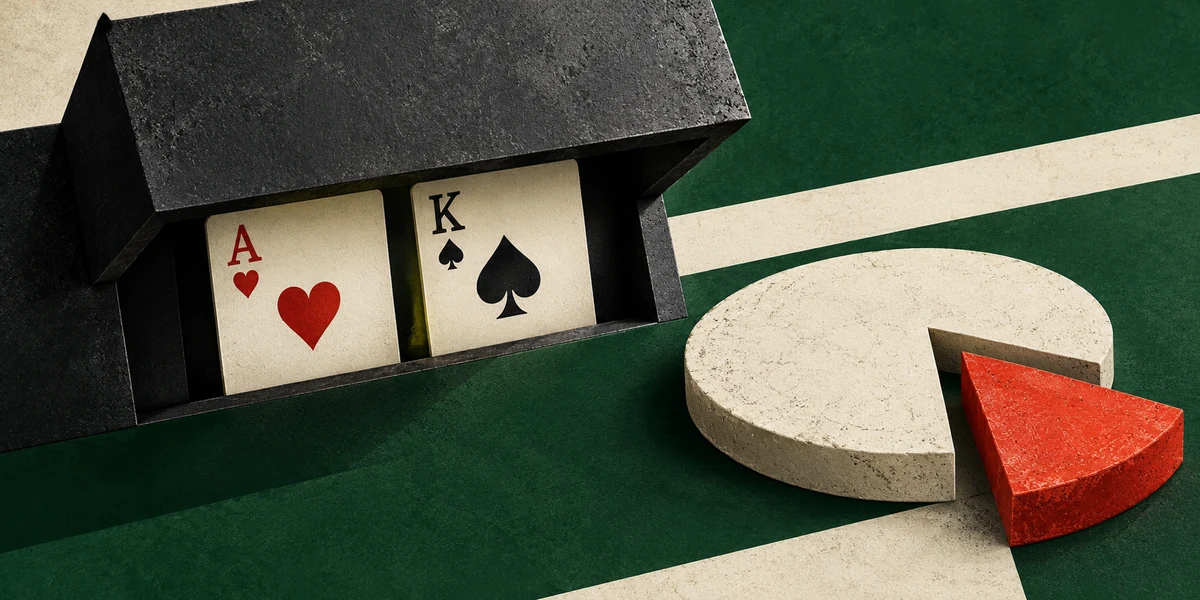
Every new player who walks up to a Double Exposure table has the same reaction. Both dealer cards are face up. No hole card. No guessing. For a split second it feels like the casino made a mistake and left the vault door open.
It didn't. Double Exposure Blackjack, also sold in European rooms as Face Up 21 or Dealer Disclosure, is one of the most carefully balanced trades in the pit. The casino gives you perfect information about the dealer's starting hand, and in return it takes two things that quietly fund your entire game: your pushes and your 3:2 blackjack payout. The deal can be close to fair, or it can be a slow bleed, depending on the fine print and on whether you're willing to play hands that look insane by standard rules.
This guide covers how the game works, where the money goes, and the strategy changes you need to make at the table.
How Double Exposure Works
The flow is familiar. You bet, the dealer deals two cards to each player and two to themselves. The difference is that both dealer cards land face up before anyone acts. You see "dealer has 10-6, a hard 16" instead of "dealer shows a 10." Every decision you make is against a known starting total.
In regular blackjack, nearly every hard decision comes down to the hole card. When you stand on 16 against a 10 or surrender it, you're working with probabilities across thousands of possible dealer outcomes. Double Exposure removes that layer. The only unknowns left are your next card and the dealer's draws.
That information is very valuable. Simulations of standard blackjack where the player can legally see the hole card show a swing in the player's favor of roughly 9 to 10 percent. If the casino offered that with no strings attached, you'd be playing with a large edge. So the casino attaches strings.
Key Concept
Double Exposure is an information-for-equity swap. Seeing the dealer's hole card is worth roughly 9–10% to a perfect player. The casino takes nearly all of that back through tie rules and reduced blackjack payouts. Whether you end up near break-even or deep underwater depends on your strategy and the secondary rules on that specific table.
The Price Tag: Where Your Equity Goes
Offset #1: The Dealer Wins Ties
This is the main cost. In Double Exposure, the dealer wins all ties. The usual exception is a player natural, which is generally protected, though how a player blackjack fares against a dealer blackjack varies by house, so read the felt. Your 19 against the dealer's 19 is no longer a push. It loses.
Pushes happen often. In standard multi-deck blackjack, about 8.5% of all hand resolutions are ties. Over a long session, roughly one hand in twelve normally returns your bet. In Double Exposure, each of those becomes a full loss. Before strategy adjustments, that is close to an 8.5% swing toward the house, which takes most of the value of the visible hole card in a single rule.
Better play recovers part of it. Because you can see the dealer's total, you can sometimes avoid a tie by hitting into it, which is the source of the unusual strategy plays below. You won't recover all of it. The tie rule is the main reason this game pays the casino's rent, and you can see how the conversion from pushes to losses works out at the hand level in this breakdown of tie resolution expected value on BlackjackMath.org.
Offset #2: Blackjack Pays Even Money
The second cost is smaller but steady. Player naturals pay 1:1 instead of 3:2. You'll be dealt a blackjack about 4.75% of the time, and losing half a unit of profit on each one costs roughly 2.3% of house edge. Players tend to underestimate this, because a blackjack still feels like a win. It is a win, just a smaller one than the 3:2 payout that keeps the standard game close to even.
Offset #3: Doubling and Splitting Restrictions
Here the casinos differ most. Many Double Exposure tables cut back on the moves that let you profit from visible dealer weakness:
- Doubling limited to hard 9, 10, and 11. This removes soft doubles and low hard doubles against dealer stiffs, which are among your best plays in this game.
- No double after split (DAS). When the dealer is sitting on a hard 15, you want to split and then double. Losing DAS takes away part of your offense.
- One split only, no resplitting. Pairs that keep coming against a visible dealer 14 lose value when you can't keep separating them.
- Dealer hits soft 17, which is a small but real extra cost.
These restrictions do the most harm in this variant because doubling and splitting against a known dealer stiff is your main source of profit. In standard blackjack, doubling 11 against a 6 is a strong play. In Double Exposure, doubling against a confirmed hard 16 is stronger still, and a casino that restricts it is taking away your best opportunities.
| Rule / Factor | Standard Blackjack | Double Exposure | Approx. Impact on Player |
|---|---|---|---|
| Dealer hole card | Hidden | Face up | ≈ +9 to +10% (player gain) |
| Ties (pushes) | Bet returned | Dealer wins (except player naturals) | ≈ −8.5% before adjustments |
| Blackjack payout | 3:2 | 1:1 | ≈ −2.3% |
| Doubling | Usually any two cards | Often hard 9–11 only | −0.2% to −0.4% (variant-dependent) |
| Double after split | Commonly allowed | Frequently prohibited | ≈ −0.15% to −0.2% |
| Resplitting | Up to 3–4 hands | Often one split only | ≈ −0.05% to −0.1% |
| Net house edge (perfect strategy) | ~0.4%–0.6% (good 6-deck rules) | ~0.67% (liberal) to 1.47%+ (restrictive) | Rule set decides everything |
The full combinatorial work behind these figures, including per-rule decomposition across deck counts, is available in the Double Exposure mathematical analysis on BlackjackMath.org. I won't reproduce the matrices here. What matters at the table is simple: on a liberal table played well, Double Exposure costs about the same as a mediocre standard game. On a restrictive table, it costs well over a percent. Use the Table Grader tool to enter the exact rule card and see which kind of table you're looking at before you buy in.
Warning:
The "I can see everything" feeling is what the casino is selling. Players who play standard basic strategy on a Double Exposure table, standing on 17 against a dealer 17 or standing on 19 against a dealer 20, routinely face a house edge of several percent. Seeing the cards only helps if you change how you act on them.
Radical Strategy Inversions: Plays That Look Wrong and Aren't
Standard basic strategy is built for an unknown hole card and a push-friendly tie rule. Neither applies here. Your decisions have to be rebuilt around two facts: you know the dealer's starting total, and a tie counts as a loss. Some of the correct plays will look reckless, but each one follows directly from the math.
Hitting Hard 19 and Hard 20 Against a Dealer 20
Say the dealer has K-Q, a hard 20. You have 10-9. In any other game you'd stand without thinking. Here, standing on 19 loses every time, because the dealer stands on 20 and beats you.
So you hit. A 2 gives you 21 and the win. An ace brings you to 20, which ties and still loses, but you weren't going to lose any more than you already were. Any other card busts a hand that was already lost. Hitting can't make your result worse, and it gives you a real chance to win. It costs nothing.
The same reasoning applies to a hard 20 against a dealer's 20. Standing ties, and a tie loses. Hitting wins only on an ace, but a small chance of winning is better than a certain loss. If you're holding two tens, you might consider splitting, but in most rule sets simply hitting the 20 comes out ahead of splitting into two hands that each need to reach exactly 21. Players feel strongly that hitting a 20 is wrong. Against a visible dealer 20 with ties going to the house, it's the correct play.
Hitting Hard 17 Against a Dealer 17
The dealer has 10-7, a hard 17, and will stand. You have hard 17. Standing ties, and a tie loses. Your only chance is to draw: an ace through a 4 brings you to 18–21 and beats the dealer's 17. Anything higher busts a hand that was already lost.
This extends to the general rule: whenever the dealer holds a standing total and your hard total is equal to or lower than it, you hit. Hard 17 against 18, hard 18 against 18, hard 18 against 19, and so on. Standing locks in a loss. Watch for soft 17 if the table has the dealer hit soft 17. In that case the dealer's hand isn't final yet, and the situation changes.
Standing on Stiffs Against Dealer Hard 13–16
Now the reverse. The dealer has 9-6, a hard 15, and must draw. You have 10-3, a hard 13.
In standard blackjack against a 9 upcard you'd hit. Here you can see that the dealer is drawing to a stiff, so you stand. The dealer can only beat you by first avoiding a bust, and any card that doesn't bust leaves the dealer with 17 or more, which would beat your 13 regardless. That means hitting your stiff mostly gives you new ways to bust while doing little to improve your chances of winning. If the dealer busts, you win whether you're holding 12 or 20.
The resulting rule is clean: against a dealer's visible hard 13, 14, 15, or 16, stand on hard 12 through 16. This holds whether your stiff is two cards or five, which makes it simpler than many decisions in the standard game. Against a dealer hard 12, the picture is close enough that you should check a rule-specific chart, but standing is generally correct there too. For a detailed look at how these hands behave in the standard game, see our stiff hands guide. For the cases where the exact cards in your hand matter more than the total, our composition-dependent hands guide explains why Double Exposure removes many of those fine distinctions.
Sharp Tip (Marcus Vance):
Your profit in Double Exposure comes from dealer stiffs. When you see a hard 13–16, play aggressively: double every hand the rules allow, split pairs you'd never split in the standard game (including 10s against a visible 15 or 16 where splitting is permitted and the chart supports it), and double soft hands if the table lets you. When the dealer shows a made hand, your job switches to avoiding ties. Most of the skill in this game is knowing which of those two situations you're in.
Quick-Reference: Signature Double Exposure Plays
| Your Hand | Dealer's Visible Total | Standard Play | Double Exposure Play | Why |
|---|---|---|---|---|
| Hard 19 | Hard 20 | Stand | Hit | Standing always loses |
| Hard 20 | Hard 20 | Stand | Hit | Tie = loss; only an ace wins |
| Hard 17 | Hard 17 | Stand | Hit | Ace through 4 wins |
| Hard 18 | Hard 18 or 19 | Stand | Hit | Standing locks in a loss |
| Hard 12–16 | Hard 13–16 | Varies by upcard | Stand | Dealer bust is your only path |
| Hard 9–11 / soft hands | Hard 13–16 | Varies | Double (if allowed) | Maximize bets on dealer weakness |
This table covers the main plays, not the full strategy. A complete Double Exposure chart is a matrix of your hand against the dealer's total, not your hand against an upcard, and it changes with soft 17 rules, doubling limits, and DAS. Build one for your exact table with the Strategy Chart Builder tool and practice it before you put money down. Playing from memory of the standard chart is how players lose money in this game.
Why Double Exposure Is a Poor Counting Game
Card counters sometimes assume that more visible cards means more information and therefore more edge. In practice, Double Exposure is one of the worst places to count, for several reasons that compound each other.
The base edge is deeper. A counter's profit comes from the difference between the true count and the house edge. On a standard 0.5% game, each true count point moves you roughly half a percent, so you reach break-even quickly. On a Double Exposure table starting at 0.67%, and often well over 1% once the restrictions are applied, you need noticeably higher counts before your large bets have an advantage. You spend more of the shoe waiting at minimum bets.
The game's core value moves away from the count. In standard blackjack, the count helps in two ways: it tells you when the deck favors you, and it guides strategy deviations that partly compensate for the hidden hole card. Double Exposure already gives you the hole card. Many of the deviations that make counting valuable become unnecessary, because you're no longer estimating the dealer's hand. You know it.
Rich decks pay less. A high count means more tens and aces. In standard blackjack, the extra aces produce more 3:2 blackjacks, which is a big part of why positive counts are profitable. In Double Exposure, those blackjacks pay even money. Ten-rich shoes also produce more 20-versus-20 standoffs, and with ties going to the house, those count against you.
Operators deal it to limit counters. To be clear, ties don't mechanically shorten the shoe. But casinos usually run Double Exposure as a specialty game with six or eight decks, shallow cut-card placement, or continuous shuffling machines. Combine poor penetration with a high starting edge and reduced value from rich decks, and the counting edge mostly disappears. If you count, there are much better games to spend your time on.
Should You Play It at All?
Double Exposure isn't a trap by default. On a liberal table, with double on any two cards, resplitting, DAS, and the dealer standing on soft 17, a disciplined player who uses the inverted strategy faces an edge in the 0.67% range. That's worse than a strong standard game but better than most 6:5 tables on the Strip, and the game is interesting to play. Hitting a 20 against a dealer's 20 and occasionally winning is one of the more satisfying moments available at a blackjack table.
On a restrictive table, with doubling limited to 9–11, no DAS, one split only, and the dealer hitting soft 17, you're paying close to 1.5% or more for the novelty. Compare it with your other options. Our Blackjack Variants overview ranks Double Exposure against Spanish 21, Blackjack Switch, Free Bet, and the rest, so you can judge whether this table is worth your bankroll or whether you should keep walking.
Warning:
Some Double Exposure tables advertise a side bet or "bonus" payout on specific hands to make up for the even-money blackjack. Treat these like any other side bet: assume a high house edge until the math shows otherwise. A promotional payout doesn't offset the tie rule.
Bottom Line
Seeing both dealer cards is worth roughly 9–10%, and the casino takes nearly all of it back: about 8.5% through ties going to the dealer and about 2.3% through even-money blackjacks, with doubling and splitting restrictions taking more. The resulting edge ranges from about 0.67% on liberal tables to 1.47% or more on restrictive ones. Your results depend on abandoning standard basic strategy. Hit hard 17 against a dealer 17. Hit 19 and even 20 against a dealer 20. Stand on every stiff against a visible hard 13–16, and double and split aggressively when the dealer is drawing to bust. Grade the table before you sit down, build a chart for that exact rule set, and don't count cards here. Seeing the dealer's cards only pays off if you change your play to match.