
Two blackjack logs both show 43 wins in 100 starting rounds. One reports a win rate of about 48%, the other about 51%. Neither has to contain a counting error. One calculation divides by 90 decisive rounds, and the other divides by 85. Both divide the same number of wins by a denominator that excludes ties. To understand what happened to the balance, you still need the losses, the returned stakes and the payouts.
Record a returned stake in its own category
In the simple accounting used here, a push returns the stake on the tied main wager. A one-unit push has a gross return of one unit and a net result of zero. An ordinary one-unit win at even money returns two units in total and adds one unit to the balance. A loss returns zero and reduces the balance by one. Use the posted rules to decide how a hand settles. The count on the cards does not settle every variant in the same way.
For a concrete source, the Massachusetts Gaming Commission's blackjack rules describe settlement and distinguish a natural blackjack from other totals of 21. That source is useful for seeing why a tie needs a rule rather than a label guessed from the screen. In this worksheet the log already labels each settled wager. There is one main wager per round, with no insurance, side bets, splits, doubles or surrender. We will change the payout for some of the wins later.
Recalculate both percentages from the same counts
Log A contains 43 wins, 47 losses and 10 pushes. Log B contains 43 wins, 42 losses and 15 pushes. All rows are synthetic and both logs have 100 starting rounds. Counting wins among all starts gives 43% in both. Among wins and losses only, log A gives 43 divided by 90, or 47.78% after rounding. Log B gives 43 divided by 85, or 50.59%. The proportion of decisive rounds is different, so the same number of wins takes a larger share of the second denominator.
| Log | Wins | Losses | Pushes | All starts | Decisive rounds | Net units |
|---|---|---|---|---|---|---|
| A | 43 | 47 | 10 | 43% | 47.78% | −4 |
| B | 43 | 42 | 15 | 43% | 50.59% | 1 |
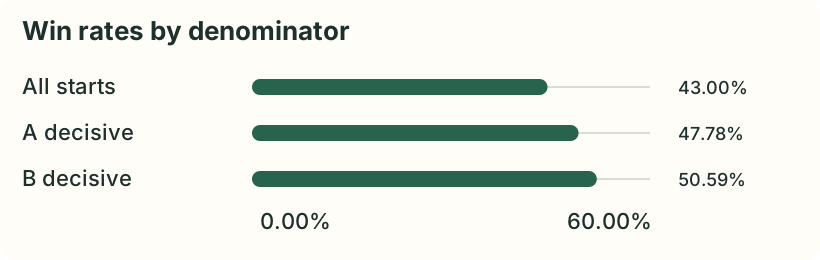
Under the flat one-unit and even-money assumptions, A loses four units and B gains one. The ten returned stakes in A bring back ten of the 100 units originally put down. Add 86 units of gross return from 43 wins and you get 96. In B, the 15 pushes plus the same 86 from wins give 101. Those totals reconcile the difference in balance. The results reflect invented counts. They do not estimate the odds or long-run cost of a particular table.
Change the payment and keep the win count
Now take log A and assume four of the 43 wins are qualifying naturals paid at 3:2. These four are already included in the win total. Each returns the stake plus 1.50 units of profit instead of the one-unit profit used before. That adds 0.50 per natural and two units in total. The same log now loses two units, with no change in either win-rate denominator. Counting the four naturals as additional wins would count the same rounds twice.
A different example makes the same point without naturals. A double of a one-unit initial stake adds a second unit. If the doubled hand loses, its net cost is two units even though it is one losing hand. If it pushes with the doubled amount returned under the applicable rules, the gross return is two and the net is zero. A percentage of winning hands cannot capture that change in exposure. Store the money risked and money returned for each settled wager.
Keep starting rounds, hands and wagers separate
A split can turn a single starting round into two settled hands. Suppose both hands have one unit at risk. One wins at even money and the other loses. The round nets zero, yet the two hand outcomes are a win and a loss. Marking this round as a push would hide how it reached zero. In a session where splits occur, a per-hand rate and a per-starting-round rate need separate labels. Counting every post-split hand while keeping only the original round count creates a mismatched fraction.
A side bet can also settle independently of the main wager. If the main hand pushes but an additional one-unit wager loses, the main wager returned its stake and the whole round lost one unit. Keep the side result separate when measuring main-hand outcomes. If you want a wallet result, aggregate all wagers within the scope. Specify whether exposure means original stakes or all accepted stakes after additions. A return per original unit and a return per unit actually wagered answer different accounting questions.
Compare the report with the original wallet movements
For a single settled main wager, gross return minus total accepted stake gives the net. Use that equation on every line before grouping the outcomes. In log A the amount at risk is 100 and the total return is 96 under the flat assumptions. The four qualifying naturals raise the return to 98, which reproduces the second net of −2. Splits and doubles require the actual accepted amounts, rather than assigning one unit to every hand. If a report shows only an overall win rate, the wallet movements are a separate piece of evidence that can settle the accounting question.
Give the next reader enough information to rebuild the result
The useful minimum is a round identifier, a hand identifier when needed, initial stake, additional amount, gross return and settlement category. A rule note should say what counted as a main-wager push and how any unmatched or void entries were handled. Keep the event records if the application rolls split and side-wager outcomes into one line. Do not infer pushes from zero net result alone. Use the recorded settlement or mark the classification unresolved.
I would report wins, losses and pushes as counts, then both rates with their denominators, then the net result and exposure on the same scope. For log A the decisive win rate describes 90 of 100 starts. For the version that pays four naturals at 3:2, the balance depends on how those wins are paid. Once the report exposes both the counts and the amounts, a reader can tell which part of a change came from the outcomes and which part came from the payout rules.