Most blackjack players lose money before they make a single decision. They don't lose it on a bad split or a missed double down. They lose it the moment they pull out a chair at the wrong table. Of all the mistakes I see, sitting at a 6:5 blackjack table is the most expensive one that's also the easiest to avoid. It takes about two seconds to spot, and it costs the average player hundreds of dollars over a single weekend.
This guide breaks down what the 6:5 payout does to your money, where casinos put these tables, and how to read the felt so you never sit at one by accident. Once you understand the numbers, you will treat a 6:5 sign the way a pilot treats a fuel warning light.
The Anatomy of the 6:5 Payout Trap
Blackjack's reputation as the "best bet in the casino" rests on one feature: the natural. When your first two cards are an Ace and a ten-value card, and the dealer doesn't also have blackjack, you get paid a bonus. For most of the game's history, that bonus was 3:2. You won one and a half times your bet.
That bonus is not a gift. It is part of the game's structure. The dealer acts last, so you lose every hand where you bust, even when the dealer busts too. That gives the house a big built-in edge. The 3:2 natural, along with doubling, splitting and surrender, is one of the main tools that offsets it. Take that bonus away and the game becomes much worse for you.
The 6:5 table does exactly that. It looks like blackjack. The cards, the dealer and the felt are the same, so most people never notice the change. Here is what has actually happened: the casino has quietly cut your single most valuable payout by 20%.
The Payout Arithmetic: Real Dollars on Real Bets
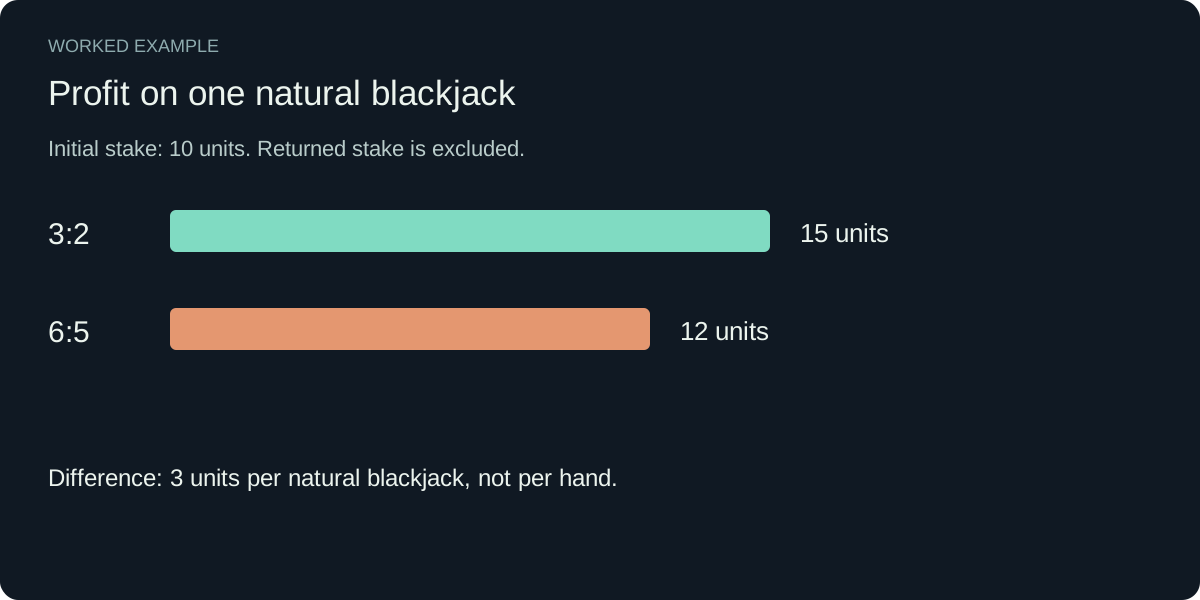
Here are the numbers on one hand. On a $25 bet, a natural at a 3:2 table pays $37.50. The same natural at a 6:5 table pays $30.00. That is $7.50 gone on the best hand in the game, and it happens every time you're dealt a blackjack.
| Bet Size | 3:2 Natural Pays | 6:5 Natural Pays | Lost Per Natural |
|---|---|---|---|
| $10 | $15.00 | $12.00 | −$3.00 |
| $15 | $22.50 | $18.00 | −$4.50 |
| $25 | $37.50 | $30.00 | −$7.50 |
| $50 | $75.00 | $60.00 | −$15.00 |
| $100 | $150.00 | $120.00 | −$30.00 |
A few dollars per natural may not sound like a disaster. That is exactly why the 6:5 game works so well for the casino. The loss on any one hand is small enough to shrug off. The damage comes from how often it repeats.
How Often Naturals Actually Happen
With a standard multi-deck shoe, you'll be dealt a natural on about 4.74% of hands. That is roughly one blackjack every 21.1 hands. At a busy table dealing 70 to 80 rounds an hour, you'll see three or four naturals every hour. Playing heads-up with a fast dealer, you can easily see five or more.
Now multiply. Over 100 hands at $25, you can expect about 4.74 naturals. At $7.50 lost per natural, that is about $35.55 drained from your bankroll every 100 hands. You didn't make a single strategy mistake to lose it. You just picked the wrong chair.
Key Takeaway
The 6:5 payout charges you on your best hand, roughly once every 21 hands, all session long. At $25 a hand, that comes to $35 or more every 100 hands. No bet sizing, card counting or perfect basic strategy can win that money back.
The House Edge Impact: From Fair Game to Predator
Dollars per hand show you the symptom. The house edge shows you the cause. Changing the natural payout from 3:2 to 6:5 adds about +1.39% to the house edge. That is not a small rules tweak. For comparison, whether the dealer hits or stands on soft 17 shifts the edge by about 0.2%. Surrender is worth less than 0.1% in most games. The 6:5 payout is several times bigger than almost any other rule on the table.
Look at what it does to a good game. A solid 3:2 shoe game, with the dealer standing on soft 17, double after split allowed and late surrender, runs at about a 0.50% house edge for a basic strategy player. Apply the 6:5 payout to the same game and the edge jumps to about 1.89%. That nearly quadruples the casino's advantage.
You can test these rule combinations yourself with the house edge calculator on BlackjackMath.org. Enter the same rules, change only the natural payout, and watch the number move. If you want the full derivation of where the 1.39% comes from, including the adjustment for hands where the dealer also has blackjack, read the 3:2 vs 6:5 math proof on BlackjackMath.org. I won't repeat that proof here. Your job at the table is to act on the result, not rederive it.
How 6:5 Blackjack Stacks Up Against Other Casino Games
Here is the part that should bother anyone who chose blackjack because it's "the smart game." Once you accept 6:5, you're playing a worse game than many bets that players look down on.
| Game / Bet | Approx. House Edge | Hourly Cost at $25 × 80 Hands |
|---|---|---|
| Blackjack 3:2, good rules, basic strategy | 0.50% | ~$10 |
| Baccarat (Banker bet) | 1.06% | ~$21 |
| Baccarat (Player bet) | 1.24% | ~$25 |
| French Roulette even-money (La Partage) | 1.35% | ~$27 |
| Craps Pass Line | 1.41% | ~$28 |
| Blackjack 6:5, same rules | 1.89% | ~$38 |
| Single-Zero (European) Roulette | 2.70% | ~$54 |
Read that table carefully. A 6:5 blackjack game is worse than both sides of baccarat. It is worse than the craps pass line. It is worse than French roulette's even-money bets with La Partage, the most player-friendly roulette rules you'll find. It is getting uncomfortably close to standard single-zero roulette, a game where your decisions don't matter at all. The difference is that in blackjack you have to play perfect basic strategy just to reach that 1.89%. Most players make a few errors an hour, so their real cost is higher.
Put another way: if you're stuck choosing between a 6:5 blackjack table and the baccarat pit, baccarat is the better bet. That's a strange thing for a blackjack editor to say, but the numbers are clear.
Sharp Tip (Marcus Vance):
Card counters, take note: 6:5 doesn't just raise the edge, it guts the main reason counting works. Your big bets go out in high counts because that's when naturals show up most often. Cut the natural's payout and you cut the return on the hands you're pushing your money into. A counted 6:5 game is a pointless exercise for nearly anyone at realistic bet spreads. Don't waste your effort or your cover on it.
Where Casinos Hide 6:5 Tables
Casinos don't put 6:5 tables in random spots. They place them where the people walking past are least likely to check the rules. Learn the pattern and you'll spot the trap before you reach the felt.
Single-Deck Tourist Traps
This is the most cynical setup in the business. Experienced players know that single-deck blackjack is, all else equal, one of the best games around. Casinos use that reputation as bait. They advertise "Single Deck Blackjack!" in big letters, then quietly pay 6:5 on naturals. The fewer decks are supposed to make the game good. The cut payout erases that benefit and then some. A 6:5 single-deck game with typical Las Vegas rules runs well over 1.3% and is often worse once you add the restrictions that usually come with it, like doubling only on 10 and 11 or no resplitting. Never assume single-deck means a good game. Check the payout first, every time.
Low-Minimum Tables ($5 and $10)
The cheapest tables in the building are more and more likely to be 6:5. The casino figures that low-stakes players are recreational, won't notice, and won't complain. Many people sit at a $10 game thinking they're "playing it safe." In fact, they're paying a much higher rate than they would at the $15 or $25 table across the aisle. A $25 bet at 3:2 with good rules costs about the same per hour as a $7 bet at 6:5. Lower minimums don't always mean lower cost.
Airport, Party Pits and Strip Main Floors
Party pits with go-go dancers and loud music, high-traffic Strip casino floors, and casino gaming areas near airports all draw people who are distracted, celebrating or killing time. These spots are full of 6:5 games, because the operators know their players care about atmosphere more than payouts. If the music is loud and the drinks are flowing, assume 6:5 until the felt tells you otherwise.
Warning:
Watch for tables that pay even money (1:1) on naturals, which are common on some continuous shuffling machines and promotional "blackjack" variants. Those are even worse than 6:5, adding about 2.3% to the house edge. Also be wary of side-bet-heavy tables. They often hide a 6:5 payout under a pile of flashy bonus wagers that carry their own steep edges.
Felt Inspection: How to Read the Table in Two Seconds
The payout rule is printed right on the layout. Casinos are required to show it. They just aren't required to make it easy to notice. Here's the routine I use before I ever pull out a chair.
Step 1: Find the Payout Arc
Look at the curved text printed across the middle of the felt, just above the betting circles. On a legitimate game it reads "Blackjack Pays 3 to 2." On a trap table it reads "Blackjack Pays 6 to 5." The font, color and placement are usually identical, so you have to read the actual numbers. Don't let a quick glance stand in for reading it.
Step 2: Confirm the Secondary Lines
The same arc usually lists "Dealer Must Stand on All 17s" or "Dealer Must Hit Soft 17," along with "Insurance Pays 2 to 1." Insurance pays 2 to 1 on every table, so don't let it distract you. The number you care about is the natural payout. Note the soft 17 rule too, since it's the next biggest factor in grading the game.
Step 3: Check the Placard
The table limit sign sometimes lists rule details like the number of decks, double-after-split and surrender. If the placard and felt seem to disagree, ask the dealer directly: "Does blackjack pay three to two here?" Dealers will answer honestly. They're not the ones who made the rule.
For a full walkthrough of every marking on the layout, read our guide on How to Read a Table. If you want to compare two tables quickly, enter the rules into our Table Grader tool. It gives each game a letter grade, and any 6:5 game drops straight to failing no matter how good its other rules are.
Sharp Tip (Marcus Vance):
When you walk into a casino you don't know, take one lap through the pit before you buy in. Read every felt and make a mental note of which tables pay 3:2 and at what minimums. It takes five minutes and can save you $30 to $40 an hour for the rest of your trip. If the whole casino is 6:5, that answers the question: go somewhere else. In Las Vegas, a 3:2 game is almost always a short walk or rideshare away.
Why Players Talk Themselves Into 6:5 Anyway
I've heard every excuse. "It's just a few bucks." "The minimum is lower, so I'm risking less." "It's single deck, so it evens out." "I'm only playing for fun." Each one falls apart when you look at the numbers.
The "few bucks" adds up to $35 or more every 100 hands at $25. The lower minimum doesn't make up for a nearly fourfold jump in the edge. Single deck doesn't even out, as we covered above. And if you're playing for fun, picture having almost four times as much playing time on the same bankroll at a 3:2 table. Losing your money faster isn't more fun.
For a deeper look at how payout structure plays out across different bet sizes and session lengths, see our 3:2 vs 6:5 detailed spoke guide.
Key Takeaway
The non-negotiable rule: never sit at a 6:5 table under any circumstance. Not for a few hands, not for low stakes, and not for single deck. If the only blackjack available pays 6:5, play something else, leave, or don't play. Each of those choices is mathematically better than accepting the trap.
The Action Plan
Here's what to do starting with your next trip:
- Read the felt before you buy in. Find "Blackjack Pays 3 to 2." If it says 6 to 5, keep walking.
- Distrust single-deck advertising. Check the payout first. A 6:5 single-deck game is a trap.
- Move up a level if you have to. A $15 3:2 table is cheaper per hour than a $10 6:5 table for nearly any player.
- Leave the casino if necessary. No property is so convenient that it's worth quadrupling your expected loss.
- Grade every game. Use the Table Grader to compare rule sets, and let the house edge decide where you sit, not the atmosphere.
Basic strategy, bankroll management and table selection are the three pillars of smart blackjack play. Table selection comes first because it sets the ceiling for everything else. Perfect play at a 6:5 table still loses money faster than average play at a good 3:2 game. Get the chair right first, then focus on the cards.
Bottom Line
A 6:5 payout takes $7.50 from every $25 natural. Naturals arrive about once every 21 hands, so that comes to roughly $35 or more every 100 hands. It adds about 1.39% to the house edge and turns a strong 0.50% game into a 1.89% game that's worse than baccarat, the craps pass line and French roulette's even-money bets. Casinos put these tables in single-deck tourist traps, low-minimum sections and party pits, counting on you not to read the felt. Read it every time. If it says "Blackjack Pays 6 to 5," stand up and walk away. That rule never has an exception.